CACP Program Backgrounder
The Canadian Angus Association established the Canadian Angus Certification Program in 1999. The CACP is a comprehensive, integrated identification program for commercial cattle of Angus origin. This program encourages participation from all sectors representing the production chain, from the seedstock producer to the packer.
Program Objectives
Provide genotype identification of Angus and Angus-influence commercial cattle, regardless of coat color.
Increase the value and use of registered Angus seedstock in commercial operations.
Provide useful information to producers interested in developing value-based marketing strategies and incorporating quality assurance principles in their management systems.
Deliver a service to purebred and commercial Angus and Angus-influenced cattle producers to identify cattle following the requirements mandated by the Canadian Cattle Identification Agency.
Requirements:
All animals identified with a CACP-Angus tag must be the offspring of at least one registered Angus parent.
Accepted as evidence will be a current transfer of ownership paper, signed affidavit from community pasture identifying the bull(s) used, semen sales slip, embryo transfer slip, lease certificate, signed affidavit identifying bull in a family co-owned herd, signed affidavit from original breeder identifying the registered Angus bull in the case of bred females being sold.
The CAA is responsible for writing the specifications of the program whereby certification means the genotypic verification of an animal. In other words, if it has an Angus tag, it is at least 1/2 Angus.
Certification
The Canadian Angus Certification Program is a voluntary program available for producers of commercial cattle that use registered Angus parent stock. The program is not legally binding.
Anyone owning, managing, or representing a group of calves is able enroll them. If someone other than the original breeder wants to enroll the calves, additional verification of parentage is required. Contact with the original owner/breeder is necessary and we can assist you with this.
Calves can be certified at any time before they are loaded on to the truck when sold to slaughter. So, calves can be tagged at birth, weaning, upon entering a feedlot, etc. If an animal already has a CCIA approved tag, the Angus tag must be cross-referenced with the original CCIA tag number. The original CCIA tag can NOT be removed, therefore the calf would bear two tags: the original CCIA tag and the Angus tag.
Only the CAA can certify calves. The procedures for certification are outlined below.
 1. Fill out a CACP tag order form. You will need to include your name, address, telephone number, CCIA PIN number, Angus ID number, and registration number(s) of registered Angus seedstock.
2. The CAA will verify eligibility of the cattle. This may be done on the same day.
3. After the order is processed, tags will be shipped the next day regular Canada Post. If there is a rush order, the tags may be couriered at an additional charge.
4. Upon receiving tags, the manager must sign, and send back to the CAA, the CACP Program Agreement Form stating that only eligible cattle will be tagged.
5. Eligible calves are tagged by the producer.
CACP Ear Tags and Accessories
CACP ear tags are unique to the Canadian Angus Association. They are CCIA tested and approved. They are lime-green in colour and come in a variety of brands and sizes.
The original CACP tag is the REYFLEX tag. They are available in two sizes and are packaged in groups of 50.
Reyflex tag accessories also available are tag markers, pliers, plier pins and multi-colored buttons.
New to the CACP program are the ALLFLEX tag, which is available in 3 sizes; Maxi, Large and Junior and are packaged in groups of 25.
Allflex tag accessories also available are tag markers, pliers, and plier pins.
Pre-printed number is available for all tag orders, however there is a 6-week wait on custom orders.
Marketing Opportunities
Why should you get your national ID tags through the Canadian Angus Certification Program? We're doing several things to unite producers in an effort to promote our brand - and are offering several valuable services to participants.
CACP is a branded program backed by strong advertising and marketing support designed to promote Angus as the beef of choice with key decision-makers along the food chain: from feedlots to packers, consumers to restauranteurs.
Don't forget that CACP meets and exceeds national identification requirements and provides improved trackability in the post-BSE era.
Packers are looking for CACP-tagged Angus for their Angus-brand and other quality branded beef programs.
Member producers receive the following information:
* The Feeder Fax (opens in new window) is a listing service for CACP cattle that are offered for sale. The list is updated and posted on the Canadian Angus Association's web site weekly.
* The CAA, with cooperation of auction markets across Canada, organizes CACP Feeder Sales in each region. Over 100 sales were held across Canada in 2004, all advertising CACP-tagged Angus animals. These sales have been very successful and worthwhile for Angus producers.
*The CACP Female Listing (opens in new window) is a listing service similar to the Feeder Fax, where producers can advertise replacement females that are tagged with CACP tags.
QUALITY STARTS HERE!
CACP participants will have the opportunity to become familiar with quality assurance principles and programs. We are able to provide The Quality Starts Here! (opens in new window) Good Production Practices binder as a reference for those producers looking at developing their own on-farm quality assurance program. Attention to quality assurance issues is important and may contribute to increased profitability.
Questions?
Please Contact : Phone: (403) 571-3580 Fax: (403) 571-3599
Frequently Asked Questions (FAQ's)
What is CACP?
CACP is a comprehensive, integrated identification program for commercial cattle of Angus origin. This program encourages participation from all sectors representing the production chain, from the seedstock producer to the packer.
Why the switch to Radio Frequency ID (RFID)?
The Canadian cattle industry has recognized the benefits of RFID to enhance the quality and efficiency of the national traceback system. A few benefits of the RFID (Radio Frequency Identification) tags are:
- Fewer lost or broken tags.
- Improved readability through mud and flesh.
- Automated reading without human error.
- Approved technology for any data feedback a producer can access.
Are RFID tags mandatory for all Canadian cattle?
All new manufacturing of CCIA tags will be RFID only. Bar code tags will not be eligible for sale after July 1, 2005.
How are these new RFID tags different than the old barcode dangle tags?
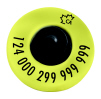
The new ear tags are circular, with a standard yellow front and a special green back unique to Angus. These tags contain a unique identification number embedded within the transponder (a computer chip that is charged by power from a tag reader).
What information is recorded on this chip and how?
The chip contains an identification number unique to each animal, as well as a country code, manufacturer code and a breed code (signifying Angus).
Is this new chip accepted as part of the National Identification Program?
Yes, and it also offers the added value of Angus marketing.
Is the computer chip contained in the round RFID tag that gets put on the cow's ear or is a chip physically implanted into the cow's skin?
The chip is encased in a plastic tag. It is NOT implanted.
Will these tags replace existing barcode ear tags or do I need both?
The new RFID tags will replace existing barcode ear tags. You do not need both (RFID tags may be required for government set-aside programs. Contact your provincial government for details). Do not remove ay existing bar coded tags.
I understand the barcode tags will no longer be manufactured. If I have some, can I continue to use them?
The tags will be "grandfathered" for an unspecified timeframe. The Canadian Cattle Identification Agency will monitor the transition and establish the final use of barcode tags.
Why should I make the switch now?
The existing tags will not be made after January 1, 2005.
What if I like marking production notes on my tags? Can I still do that with the new tags?
The RFID tags do not have space to write on. Canadian Angus is providing an optional "Angus" green tag intended for production notes.
Angus dangle tag sold in combo with RFID tag
Will these radio chips affect my satellite or radio reception?
No.
What if I choose to use a standard industry tag on my Angus cattle instead of the official Canadian Angus green tags?
Without the Angus tag you may not have access to CACP-organized fall feeder sales, or branded Angus programs across Canada.
Do I still have to keep my own records?
Just as before, the supplier maintains records of which numbers went to which producers. Primary producers are not required to maintain records. Relating birth and parentage records to an animal's tag number may provide added value.
Will these new chips make it easier to track cattle?
The move to RFID technology will improve the ease and speed of record keeping and allow full animal tracking at production, auction mart and packing plant levels.
Are these tags part of a larger plan to show the industry is accountable and willing to be proactive in ensuring quality and food safety?
Canadian Cattle Identification Program is an industry-wide program designed to promote beef consumption through assurance of efficient traceback and containment of serious animal health and food safety problems. The program is regulated and enforced by the Canadian Food Inspection Agency (CFIA).
Will I need any special equipment to put these tags onto my cattle?
The electronic Angus tags will work with an existing red Allflex "Universal Total Tagger."
What if I purchased Angus seedstock but didn't get the papers transferred?
You must have a transferred registration paper in order to buy the green Angus CACP tags.
What if I artificially inseminate my cows using registered Angus semen but didn't get a semen transfer?
A copy of a semen sales receipt or embryo transfer slip is necessary.
If selling an Angus animal, why is it in my interest to transfer the papers?
It is illegal to not transfer the papers of purebred cattle. The transfer is the key to providing marketing services for Angus customers.
Will the new tags still be green? And will the Canadian Angus Association continue to aggressively market these tags as being proof of at least 50% Angus lineage?
All national identification tags in Canada must be yellow in color. The new Angus tags will be yellow in the front and green in the back. The visible back of the tag will be the trademark Angus green. The proof of Angus influence is the breed code within the electronic chip.
What is the maximum number of tags I can get?
You are allowed 50 tags per transferred, registered Angus bull.
How can we be sure CACP-tagged cattle are 50% Angus?
If cattle have an Angus tag they are certified to be 50% Angus, regardless of the color of their hide.
Will I get a premium on my animals?
The market determines the value of the cattle and fortunately the trend is high for quality Angus-influenced cattle, both as feeders and finished cattle. The Canadian Angus Association actively promotes Angus as the beef of choice to the industry and to the retail sector.
Are other countries introducing RFID chips? Will they follow international standards?
Around the world over 25 different countries are either developing or already have individual identification programs in place. This includes the United States. All Canadian national identification tags follow international standards.
What if a tag is lost?
Apply tags to all untagged cattle permanently leaving a herd. Re-tag animals that have lost tags before they permanently leave your herd. Keep records of the tag number and the origin of the animal (including the previous tag number, if known).
Is the RFID attached to the dangle tag?
No, the RFID tag is separate from the optional dangle tag. The optional green dangle tag contains no encoded information and is being made available for producers who want to use it to record herd numbers and other production notes. If used, the optional dangle tag must not be fastened to the RFID tag.
What do the tags cost?
RFID button $3.00
Optional visual tag $1.25
Combo pkg. $4.00
Canadian Angus Certification Program FAQs
The Canadian Angus Certification Program (CACP) was first made available to cattle producers, January 1, 1999. This program identifies Angusinfluenced commercial cattle through the use of a distinctive green ANGUS ear tag. Only cattle tagged with CCIA approved Angus ear tags are part of the CACP.
What does certification mean?
Cattle with the CACP tag are offspring of a registered Angus parent. Producers that tag cattle are first checked to see that they own or lease registered Angus seedstock and then sign an agreement form stating they will only tag those calves that are eligible for certification offspring of a registered Angus parent.
What if the cattle are not black?
The Canadian Angus Association registers both Black and Red Angus. The CACP tag ensures the cattle are the offspring of at least one registered Angus parent. So cattle with the CACP tag are at least 50% Angus regardless of the coat color.
Who tags the cattle?
Anyone who owns or manages the cattle may tag them. However we must be able to verify the cattle are the offspring of a registered Angus parent, so if someone other than the original breeder tags the cattle, we need verification from that original breeder of the cattle's parentage.
Do I have to record the individual sire and dam for every calf?
No, but we recommend if it's possible that you do. Eventually, we anticipate this program will be able to collect carcass information on an individual animal. Knowing the sire and dam ID on each calf, will make this information more meaningful.
Why is there a number and bar code on the tag?
First it allows individual identification of the animal and the bar code can be easily read with a scanner. Second, the Canadian Cattle Identification Agency issues the numbers to the CACP, and the number, bar code and country code, conform to their standards. The number is associated with the bar code, each time you order, a new sequence of numbers will be registered to you.
Will I get carcass data back on the tagged cattle?
It will probably take a while before data is collected on an industry-wide scale. Our goal is to provide useful information back to the people who produced the cattle.
Will I get more money for the cattle if they have a tag?
We certainly hope so, but we have no influence on price. The market will determine the value of the cattle and fortunately the trend is high for quality Angus-influenced cattle, both as feeders and finished cattle. Through promotion and advertising we are trying to create marketing opportunities specific to the CACP tagged cattle.
What is the CACP Feeder Fax?
The CACP Feeder Fax is a listing service to promote the sales of CACP cattle. The Feeder Fax is updated weekly.
What is The CACP Female Listing?
The Commercial Female Listing is a listing service similar to the Feeder Fax, where producers can advertise replacement females that are tagged with CACP tags.
I'm an order-buyer. How can I get involved?
By understanding what the Canadian Angus Certification Program is about and recognizing the CACP tags in the field, you can help your clients get the kind of cattle they are looking for. Also, by checking the CACP Feeder Fax, you'll know where these cattle are and when they're being offered for sale.
I run an auction mart. What can this program do for me?
If you've got CACP cattle entered in your sale, let us know and we can list them on the CACP Feeder Fax, along with your auction mart and sale date.
Why would a packer get involved?
Angus cattle are known for their high quality carcass traits and ability to marble. Those packing plants involved in premium branded beef programs are looking for cattle supplies that will consistently meet or exceed the quality requirements of their branded program.
How about a feedlot?
Feedlots get involved in the program for a number of reasons. They may be sourcing Angusinfluenced feeder cattle to finish for specific markets. CACP cattle's performance in the feedlot will be more predictable because they are at least ½ Angus.
What if I remove the CACP tag?
The CACP tag is a CCIA approved tag and following federal regulations can NOT be removed from the animal. The CACP tag is the unique identification of that animal in the National Identification program.
If you have other questions about the CACP program, please call Alan Deacon at the Canadian Angus Association at 1-888-571-3580
Commercial Programs - Canadian Angus Certification Program - RFID
The switch to RFID National ID Tags
Canada's national cattle ID program has gone to RFID and the Canadian Angus CACP tags are leading the way
RFID and CACP FAQs (Frequently Asked Questions)
Program Backgrounder: Objectives, requirements and certification
Marketing Opportunities for purchasers of CACP tags
New window will open - Fill out an Order Form now
Progressive breeders are also looking at the Canadian Cattlemen's Association program for quality assurance.
NEW RFID TAGS: While the tags themselves have changed...the program remains the same.
Angus tags have always been approved tags under the national cattle identification program. And the green-backed Angus RFID tag will absolutely be the only tag you need for national ID.
But the true value of the tag is becoming part of the ongoing efforts of the Canadian Angus Association to actively promote Angus as the beef of choice.
Why the switch to RFID?
The Canadian cattle industry has recognized the benefits of RFID to enhance the quality and efficiency of the national traceback system.
The new RFID tags will replace existing barcode tags. The RFID tags contain an embedded ISO tracking number which includes an identification number unique to each animal, as well as a country code, manufacturer code, and in the case of Angus, a special breed code. The tags can be put into the ear of the animal with existing, compatible taggers.
A few benefits of the RFID are:
Improved retention: minimal lost or broken tags
Improved readability: RFID readers can read tags through flesh and mud and eliminate line of sight issues
Automated reads: no human error when recording ID numbers
Added value: RFID allows for any data feedback a producer can access
ANGUS RFID
The new RFID tags have a standard yellow front, but the Angus RFID tags will have a unique green back with a stylized "A" for Angus.
A distinct identifier number within the ISO tracking code of the RFID tag has been assigned to Canadian Angus. This number is reserved exclusively for cattle with at least one registered Angus parent.
All animals tagged with the green-backed Angus tags have international recognized proof of authenticity. Even more importantly, auction markets and packing plants will be able to use their electronic readers to quickly identify Angus animals via this special breed code embedded in the tag.
OPTIONAL DANGLE TAGS AVAILABLE
Many producers will still want to use the dangle tag to record their own management numbers. Angus will make blank tags available for this purpose. These tags will not contain any electronic information and are NOT CCIA-compliant, but will complement your CCIA-approved Angus RFID tag by providing a visible Angus identifier.